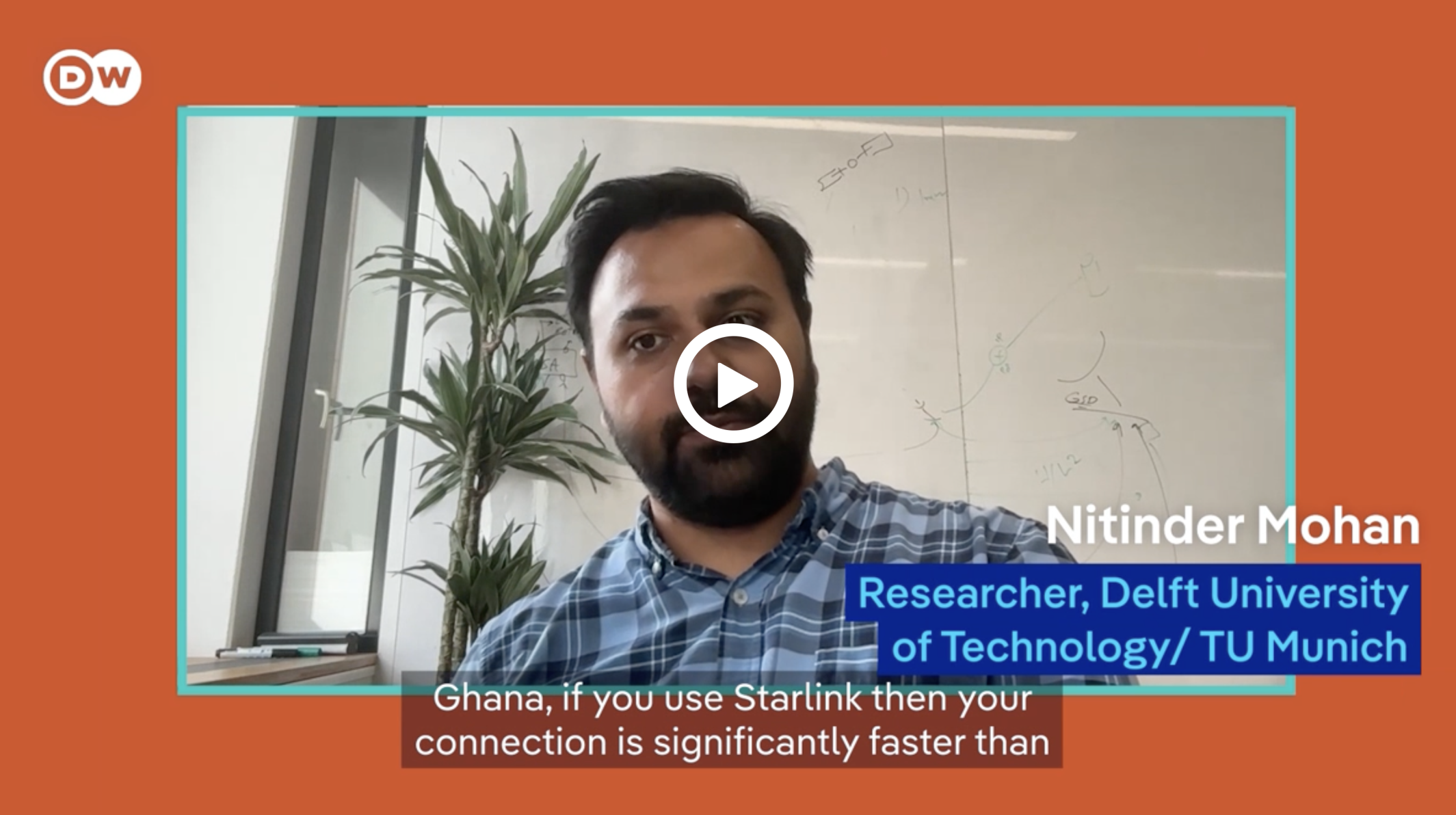
SPEAR Lab's research on Starlink and LEO satellite networks was prominently featured in a Deutsche Welle (DW) News video report examining a critical question: Is Elon Musk's Starlink satellite internet service a blessing or curse for Africa?
Deutsche Welle, Germany's international broadcaster, sought expert insights on Starlink's rapid expansion and its implications for global connectivity, network performance, infrastructure challenges, and competition dynamics with traditional ISPs and telecom providers.
The African Context
Africa presents a unique landscape for satellite Internet deployment. While the continent has seen rapid mobile phone adoption, fixed broadband infrastructure remains sparse in many regions. Traditional Internet Service Providers (ISPs) face significant challenges:
- High infrastructure deployment costs in rural areas
- Limited fiber backbone availability
- Regulatory and licensing complexities
- Economic barriers to widespread connectivity
Starlink and other LEO satellite constellations promise to bypass many of these traditional infrastructure hurdles, potentially leapfrogging terrestrial deployment challenges.
Research Insights Featured
Our research, which has been recognized with the IETF/IRTF Applied Networking Research Prize (ANRP 2025) and featured in Rest of World News, provided data-driven insights for the DW report:
Performance Reality
Based on our extensive measurements, we discussed:
- Latency characteristics: How Starlink compares to terrestrial alternatives where available
- Throughput variability: Real-world speeds across different African regions
- Ground station dependency: Impact of local infrastructure on service quality
- CDN integration: Content delivery performance and challenges
- Application suitability: What works well and what doesn't
Economic and Social Impact
- Pricing competitiveness: Starlink is now cheaper than traditional ISPs in at least five African countries
- Rural connectivity: Potential to connect underserved communities
- Digital divide: Could satellite Internet help bridge connectivity gaps?
- Infrastructure sovereignty: Implications of relying on foreign satellite infrastructure
Technical Challenges
The interview explored the often-overlooked technical aspects:
- Ground station networks: The crucial terrestrial component
- Peering arrangements: Connecting satellite providers to the Internet backbone
- Capacity constraints: What happens as more users join the network
- Local ecosystem: Integration with existing Internet infrastructure
- Regulatory landscape: Spectrum allocation and licensing across African nations
Global Deployment Patterns
Our measurements reveal interesting deployment patterns across continents:
- Africa: Significant potential for connecting rural and remote areas
- Europe: Competitive alternatives in regions with limited fiber access
- Asia-Pacific: Complex regulatory and market dynamics
- Americas: Both rural connectivity and backup/resilience use cases
The Blessing and The Curse
The DW report explored both perspectives:
Potential Blessings
- Rapid deployment without extensive ground infrastructure
- Connectivity for remote and rural communities
- Competitive pricing pressuring traditional ISPs to improve
- Support for education, healthcare, and economic development
Potential Concerns
- Dependence on foreign-controlled infrastructure
- Limited local technical capacity and jobs
- Regulatory and sovereignty questions
- Uncertain long-term pricing and service sustainability
- Environmental concerns (space debris, light pollution)
Global Implications
While the report focused on Africa, the insights apply globally to regions with similar connectivity challenges. Our research continues to track LEO satellite deployment patterns, performance evolution, and integration with terrestrial networks.
Watch the full DW News report: Is Elon Musk's Starlink in Africa a blessing or curse?
Related Research
This media coverage builds on our extensive research program:
- ACM HotNets 2024: "It's a bird? It's a plane? It's CDN!" (Best Paper Runner-up)
- ACM Web Conference 2024: Comprehensive Starlink performance study across 34 economies
- ANRP 2025: IETF/IRTF recognition for bridging research and Internet deployment
- RIPE Labs & APNIC Blog: Technical deep-dives on measurement methodologies
The DW News feature reached millions of viewers globally, helping to educate the public about LEO satellite technology, provide evidence-based analysis beyond marketing claims, highlight opportunities and challenges, and showcase academic research with real-world relevance. This is exactly the kind of real-world impact we strive for at SPEAR Lab—conducting rigorous research that directly informs technology policy, deployment decisions, and public understanding.
About DW News: Deutsche Welle (DW) is Germany's international broadcaster, providing independent news and analysis in 32 languages. DW's technology coverage reaches hundreds of millions of viewers globally across television, digital platforms, and social media.