




Edge computing brings computation closer to data sources and end users, addressing latency, bandwidth, and privacy requirements that cloud-centric architectures cannot meet. The core challenge lies in orchestrating services across fundamentally heterogeneous infrastructure: high-power edge servers with GPUs coexist with resource-constrained IoT devices across geographically distributed locations connected by networks with varying characteristics. Traditional cloud orchestration tools like Kubernetes are too heavyweight for constrained edge devices and lack the geographic awareness essential for edge deployments, where service placement must consider not just resource availability but also user proximity, data locality, and application-specific latency requirements. Managing mixed virtualization technologies—containers, virtual machines, and unikernels—within a unified framework while supporting service mobility as users move between edge locations remains a central systems challenge.
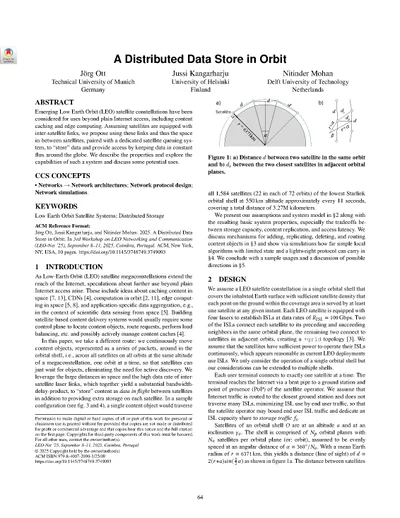
Our research develops orchestration frameworks, virtualization technologies, and resource management techniques for geo-distributed edge environments. We focus on orchestration architectures that enable system-wide coordination while allowing local placement decisions based on real-time conditions and geographic constraints. Our work addresses hybrid virtualization orchestration, enabling operators to choose appropriate virtualization technologies per-application based on security requirements and resource constraints rather than forcing uniform approaches. We explore automatic application partitioning techniques that enable distributing workloads—particularly machine learning models—across edge and cloud infrastructure without requiring manual restructuring by developers. Our open-source Oakestra platform embodies these research contributions and is actively used by research groups and industry partners for real-world edge deployments. Ongoing work addresses service mobility and state management, security in multi-tenant edge environments, and integration with emerging network technologies including LEO satellites and next-generation cellular infrastructure.




![[Poster] Resource Reservation in Information Centric Networking](/images/publications/2022/reservation_icn_poster-thumb.webp)
![[Demo] Oakestra: An Orchestration Framework for Edge Computing](/images/publications/2022/oakestraDemo-thumb.webp)