

Next-Generation Network Protocols

Protocol design and optimization for emerging network environments including LEO satellites, multipath transport, and edge computing

multipath transportMPTCPMP-QUICprotocol optimizationLEO satellite protocolsreal-time communicationhybrid networks

Research Impact

Publications8
Active Projects1
Team Members3

Network infrastructure is evolving with LEO satellite constellations, next-generation cellular networks, and edge computing, yet transport protocols were designed assuming relatively stable network paths, homogeneous link characteristics, and predictable performance. These assumptions break down in modern environments where devices transition between cellular, WiFi, and satellite connectivity; where satellite motion creates dynamic topologies with time-varying latency; and where applications demand both ultra-low latency and high throughput. Traditional single-path protocols leave substantial capacity untapped when multiple network interfaces are available, and protocol parameters tuned for terrestrial networks perform poorly over satellite links with different bandwidth-delay products and loss characteristics. Understanding how protocols actually behave in these emerging environments through measurement, and designing protocol optimizations and extensions that account for their unique characteristics, remains essential research.

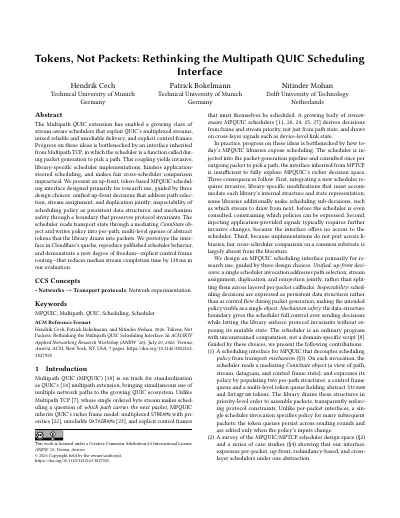
Our research develops protocol optimizations for emerging network environments informed by empirical measurements. We study multipath transport protocols that enable simultaneous use of multiple network interfaces—WiFi, cellular, and satellite—for bandwidth aggregation, seamless failover, and mobility support. Work on packet scheduling algorithms, per-path congestion control, and energy-aware multipath operation addresses the challenges of heterogeneous path characteristics. For LEO satellite networks, we explore protocol adaptations including connection establishment optimizations (QUIC's benefits for satellite RTTs), connection migration as satellites move, transport parameter tuning (window scaling, buffer sizing) for satellite link characteristics, and congestion control mechanisms that distinguish satellite-specific losses from network congestion. We investigate satellite-terrestrial hybrid architectures where devices intelligently select paths based on application requirements, and real-time communication protocols optimized for edge computing scenarios. Our protocol research combines measurement-driven understanding of actual network behavior with design of optimizations and extensions suited to emerging infrastructure. We participate in IETF standardization efforts, contributing measurement insights to protocol working groups and engaging with network operators to ensure research addresses real deployment challenges.
Publications

ConferenceSatellite Networking

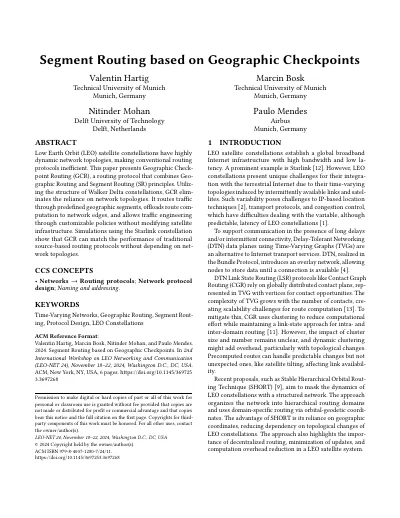
Segment Routing based on Geographic Checkpoints

ACM International Workshop on LEO Networking and Communication
Valentin Hartig
Marcin Bosk
Nitinder Mohan
Nitinder Mohan
Paulo Mendes
PDFDOI
Scholar
No citations yet
LEONET
JournalSatellite Networking

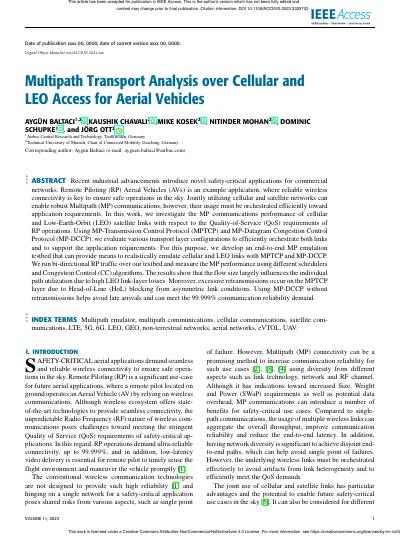
Multipath Transport Analysis over Cellular and LEO Access for Aerial Vehicles

IEEE Access
Aygun Baltaci
Kaushik Chavali
Mike Kosek
Nitinder Mohan
Nitinder Mohan
Dominic Schupke
Jörg Ott
PDFDOI
Scholar
No citations yet
Access
Artifacts Available
Artifacts Evaluated Functional
Results Reproduced
ConferenceNetworking

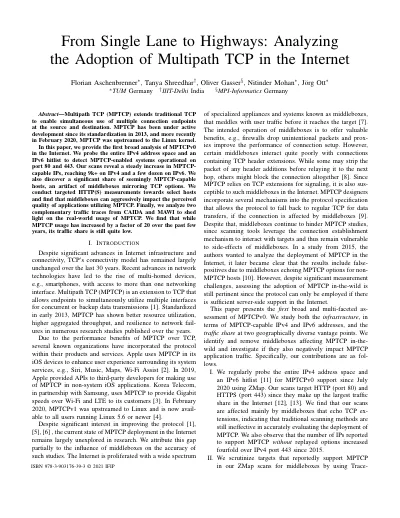
From Single Lane to Highways: Analyzing the Adoption of Multipath TCP in the Internet

IFIP Networking Conference
Florian Aschenbrenner
Tanya Shreedhar
Oliver Gasser
Nitinder Mohan
Nitinder Mohan
Jörg Ott
Networking

Open Source Contributions

MPTCP.io

MPTCP.io

Global MPTCP Deployment Scanner and Measurement Service

A public scanning service that continuously measures and tracks Multipath TCP (MPTCP) deployment across the Internet. MPTCP.io provides real-time statistics on MPTCP support among web servers, CDNs, and cloud services, helping researchers and practitioners understand the current state of MPTCP adoption worldwide.

protocolslive-service

News

Awards & Recognition

2020IEEE TCSCEdge ComputingDoctoral

Outstanding PhD Dissertation Award

IEEE Technical Committee on Scalable Computing (TCSC)

IEEE TCSC's highest honor for doctoral research, recognizing exceptional contributions to edge computing infrastructure and network protocol optimization.

Outstanding PhD Dissertation Award

Project Funding

Previous Funding

🇪🇺

Piccolo

Organization: EU Celtic-Next
Period: 2021-2024
Role: Co-Principal Investigator

Research on edge computing and distributed systems for next-generation networks. Part of EU Celtic-Next initiative supporting innovative ICT research and industry collaboration.

Learn More
🇫🇮

Adaptive and Intelligent Data (AIDA)

Organization: Academy of Finland
Period: 2019
Role: Senior Researcher

Finnish national funding for adaptive data analytics and intelligent systems. Research on network protocols, multipath transport, and performance optimization.

🇪🇺

Cleansky Initial Training Network

Organization: EU FP7 Marie Curie
Period: 2015-2018
Role: PhD Student

Marie Curie fellowship for doctoral research on mobile edge computing and content distribution. Part of EU Framework Programme 7 Initial Training Network.

Learn More

Invited Talks & Panels

View all
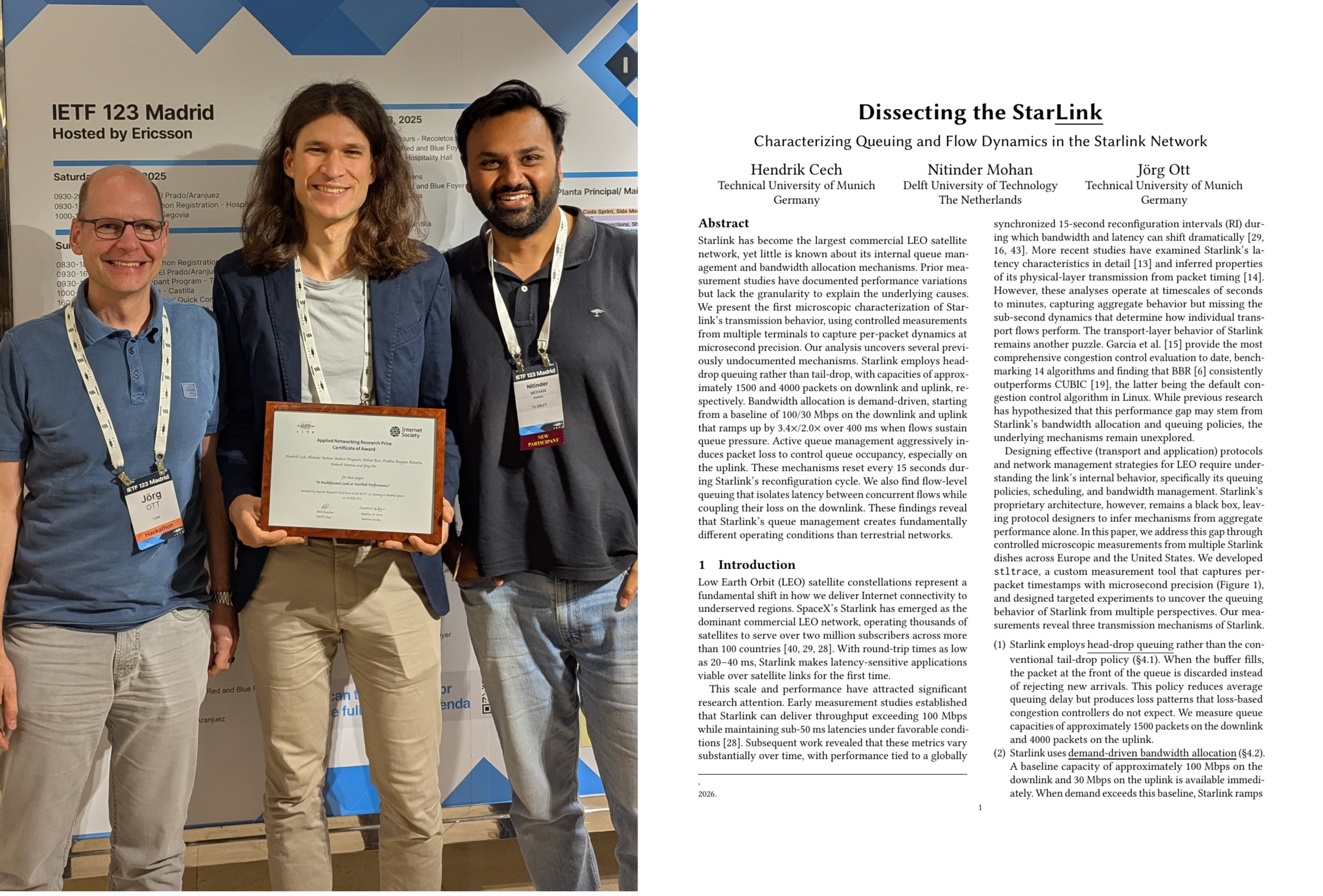
IETF 123

It's a bird? It's a plane? It's CDN!: Understanding Starlink CDN Performance

Internet Engineering Task Force (IETF) 123 - Measurement and Analysis for Protocols Research Group (MAPRG)
LEO SatellitesCDNPerformance Measurement+1 more
RIPE 90

Frontiers of LEO Space Networks: Understanding the Intricacies of Starlink's Internet Access

RIPE 90 Meeting - RIPE Network Coordination Centre
LEO SatellitesStarlinkNetwork Architecture
COMSNETS

Frontiers of LEO Space Networks: Understanding the Intricacies of Starlink's Internet Access

International Conference on Communication Systems & Networks (COMSNETS)
LEO SatellitesStarlinkNetwork Architecture

Thesis Projects

View all

Available Theses

MASTER

Middlebox support for secure communications in satellite networks

Support secure connection migration in satellite networks to enable seamless handovers without being tied to a particular Point of Presence.

Learn more →
MASTER

Secure Routing in LEO networks

Design and evaluate secure routing protocols for LEO satellite constellations that handle dynamic topology changes while preventing route hijacks and attacks.

Learn more →

Running Theses

MASTER

Multipath Media-over-QUIC (MoQ) for Video Conferencing Applications

Student: Zuji Zhou

Year: 2025

Recent Completed Theses

MASTER

Evaluating Transport Protocols for Remote Piloting of Aerial Vehicles

Student: Hendrik Cech

Year: 2021

MASTER

Feasibility Analysis of MPTCP for Remote Piloting Operations of Drones and Flying Taxis

Student: Kaushik Chavali

Year: 2021

BACHELOR

Measuring and Analysing MPTCP Support on the Internet

Student: Florian Aschenbrenner

Year: 2020