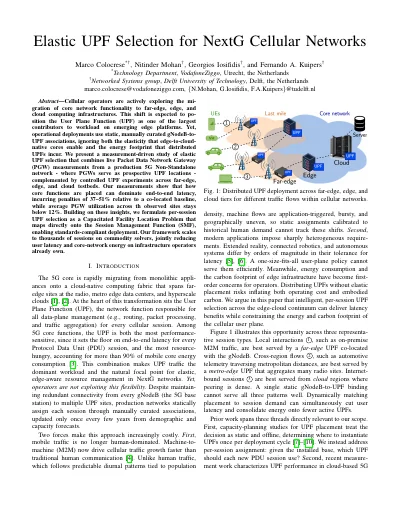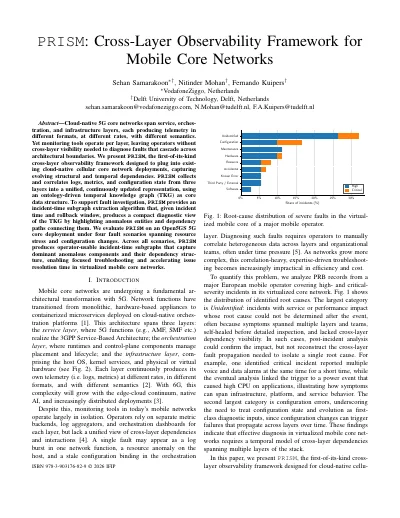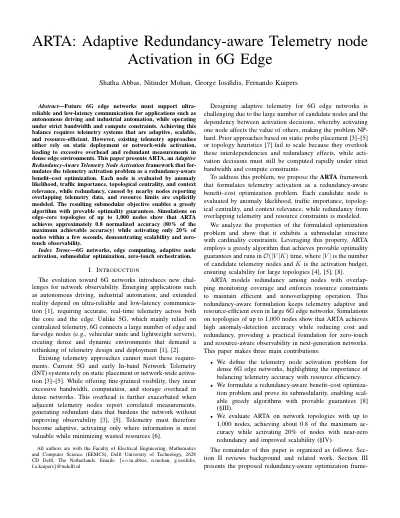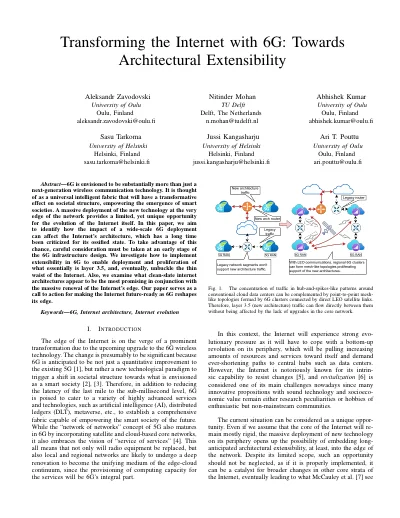




Next-generation cellular networks (beyond 5G, toward 6G) require fundamental architectural evolution to support emerging applications demanding ultra-low latency, high reliability, and ubiquitous connectivity. Current cellular architectures separate network functions from application infrastructure, requiring applications to access computational resources through multiple network hops that add latency. Emerging applications including extended reality, autonomous systems, and distributed AI workloads cannot tolerate this latency overhead. Network function virtualization and edge computing promise to address these challenges by co-locating computation with cellular base stations, but integrating edge orchestration with cellular infrastructure management—which operate under different administrative domains, use distinct control planes, and have differing resource allocation models—remains an open challenge. Furthermore, the vision of seamless integration between terrestrial cellular, satellite networks, and edge computing requires unified architectures spanning heterogeneous access technologies and infrastructure tiers.
Our research explores integration of edge computing with cellular infrastructure, investigating how edge orchestration frameworks can coordinate with cellular network management to enable low-latency application deployment. We examine architectural approaches for the edge-cloud continuum in cellular contexts, exploring hierarchical orchestration that spans cellular base stations (far-edge), regional edge data centers, and cloud resources. Work on network slicing investigates resource virtualization enabling dedicated logical networks for different application classes on shared physical infrastructure. We study protocols and mechanisms for ultra-reliable low-latency communication that leverage edge computing placement to minimize unavoidable propagation delays. Our research connects edge orchestration capabilities with cellular infrastructure, exploring how applications can benefit from cellular network's knowledge of user mobility, channel conditions, and QoS capabilities. We contribute to discussions on 6G architecture evolution, exploring how Internet architecture principles and edge computing paradigms can inform next-generation cellular design. Research directions include AI-driven network management, satellite-terrestrial integration for cellular networks, energy efficiency across edge-cellular infrastructure, and architectural extensibility enabling future protocol and application innovation.