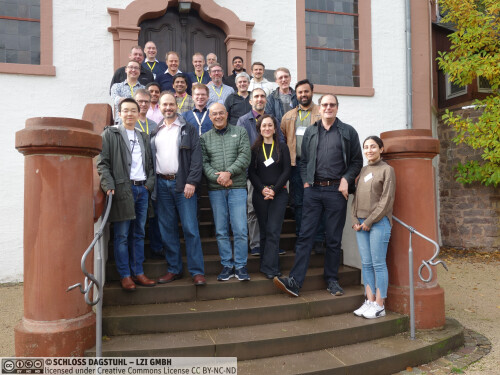
The Dagstuhl Seminar on "Edge-AI: Identifying Key Enablers in Edge Intelligence" brought together leading researchers to discuss the convergence of edge computing and artificial intelligence at Schloss Dagstuhl, Germany. The week-long seminar explored how bringing computation closer to data sources enables new classes of applications while presenting unique research challenges.
The seminar covered technical challenges like adapting ML models for resource-constrained edge devices, federated and split learning approaches, real-time inference with limited resources, data locality and privacy management, and efficient communication for distributed AI. Participants from diverse backgrounds—systems researchers, ML researchers, application developers, and industry practitioners—discussed applications ranging from autonomous vehicles and smart cities to healthcare and industrial automation.
Several important themes emerged from the discussions: edge infrastructures will inevitably remain heterogeneous, privacy concerns drive adoption of on-device processing, academia-industry collaboration is essential, interoperability standards are needed, and energy efficiency is critical for sustainability. The seminar resulted in identifying key research challenges, forming new research collaborations, and developing a roadmap for future Edge-AI research. A roadmap paper was published in ACM Computer Communication Review (CCR) based on discussions from an earlier related Dagstuhl seminar.
The insights from this seminar continue to shape our research directions on edge AI infrastructure design, federated learning at scale, distributed ML training optimizations, and application-aware resource management. This work manifests in our recent publications including USENIX ATC 2025 (on-demand container partitioning for distributed ML), EdgeSys 2025 (hybrid virtualization, Best Paper), and our Oakestra edge orchestration platform.
More Information: