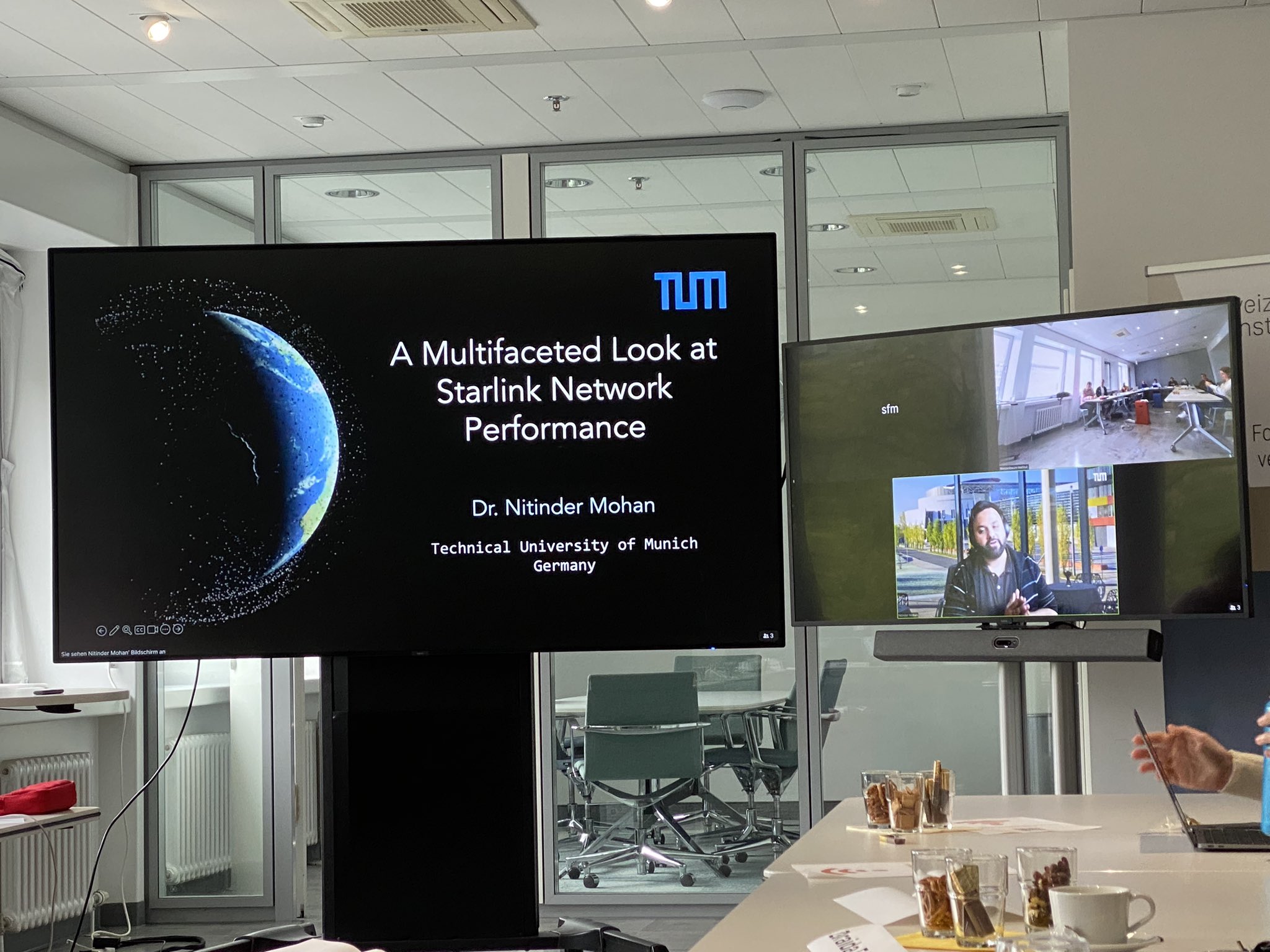
I delivered an invited talk at the 30th Biennial Conference of the International Telecommunication Society (ITS) on our extensive measurement studies of Starlink and LEO satellite networks. The ITS conference brings together economists, engineers, policymakers, and industry leaders to discuss the economic and regulatory aspects of telecommunications, making it a premier venue for interdisciplinary discussions on telecom economics, network infrastructure, digital transformation, and regulation.
My presentation provided an in-depth look at our multi-year measurement campaign characterizing Starlink's performance across different dimensions. We discussed our approach to longitudinal measurements tracking performance over time, geographic diversity across multiple continents, multi-faceted analysis of latency, throughput, reliability, and CDN performance, and our commitment to reproducible science with open methodologies. The talk highlighted key insights on performance variability due to location and network conditions, unique CDN behavior over satellite links, the critical role of ground station infrastructure, and cost-performance tradeoffs for different use cases.
ITS conferences uniquely combine technical and economic analysis. My talk bridged these perspectives by discussing what the measurements reveal about network behavior, cost structures and competitive positioning, effects on traditional ISP markets, and regulatory considerations for satellite Internet. The diverse audience brought fascinating perspectives—economists asked about market structure and competition dynamics, regulators inquired about spectrum allocation and licensing, engineers discussed technical implementation, and industry representatives shared deployment experiences.
Understanding the economics of satellite Internet is crucial because billions of dollars are being deployed in LEO constellations, satellite providers are reshaping competitive dynamics, economic viability determines reach to underserved areas, and effective regulation requires understanding costs and benefits. The discussions at ITS 2024 sparked ideas for future research on economic impact in developing markets, comparative analysis across LEO constellations, long-term sustainability of mega-constellation business models, and regulatory frameworks for global satellite connectivity.
About ITS: The International Telecommunication Society, founded in 1968, is a global community of researchers and practitioners dedicated to understanding the economics, policy, and technology of telecommunications and information industries.