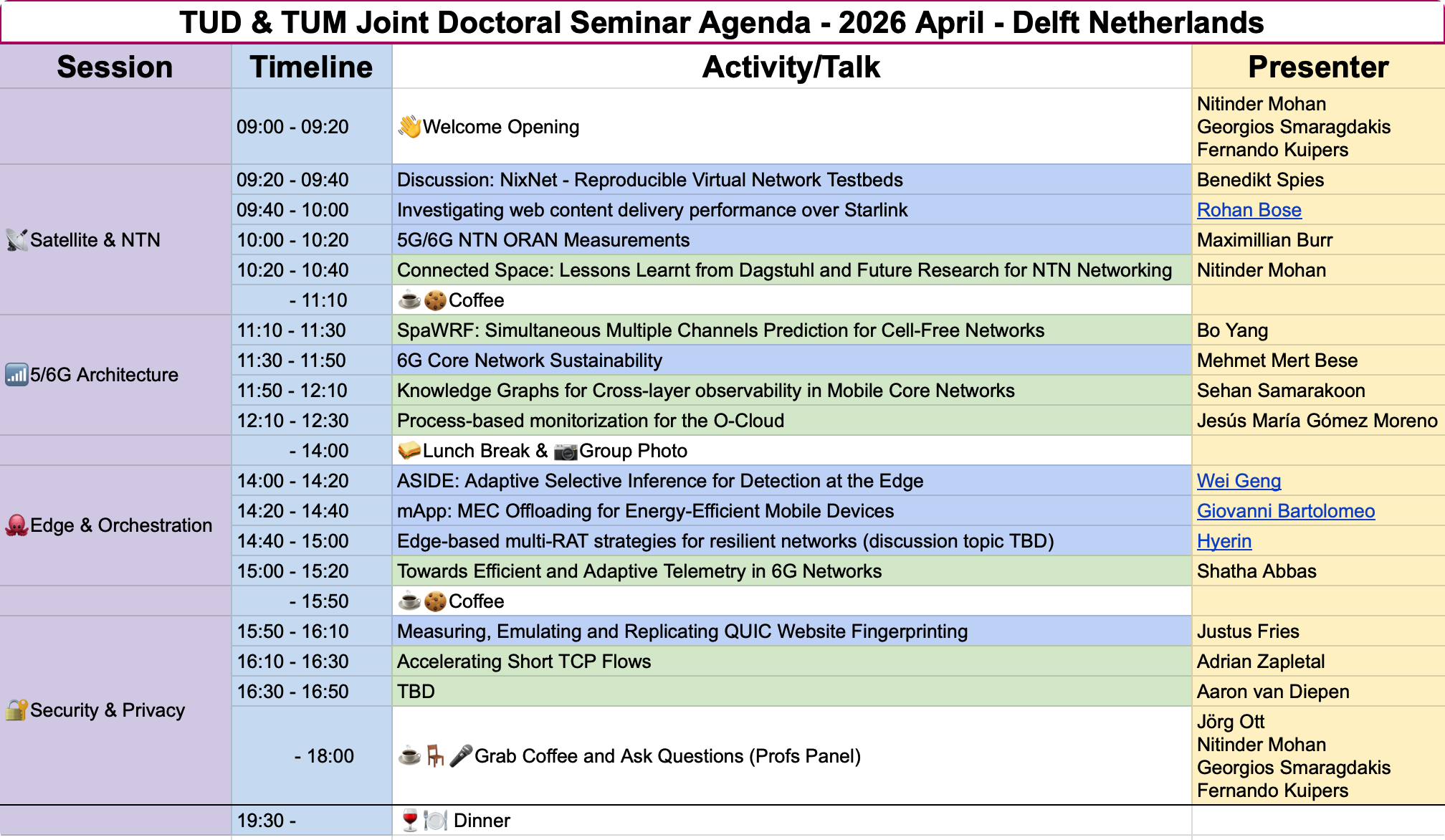
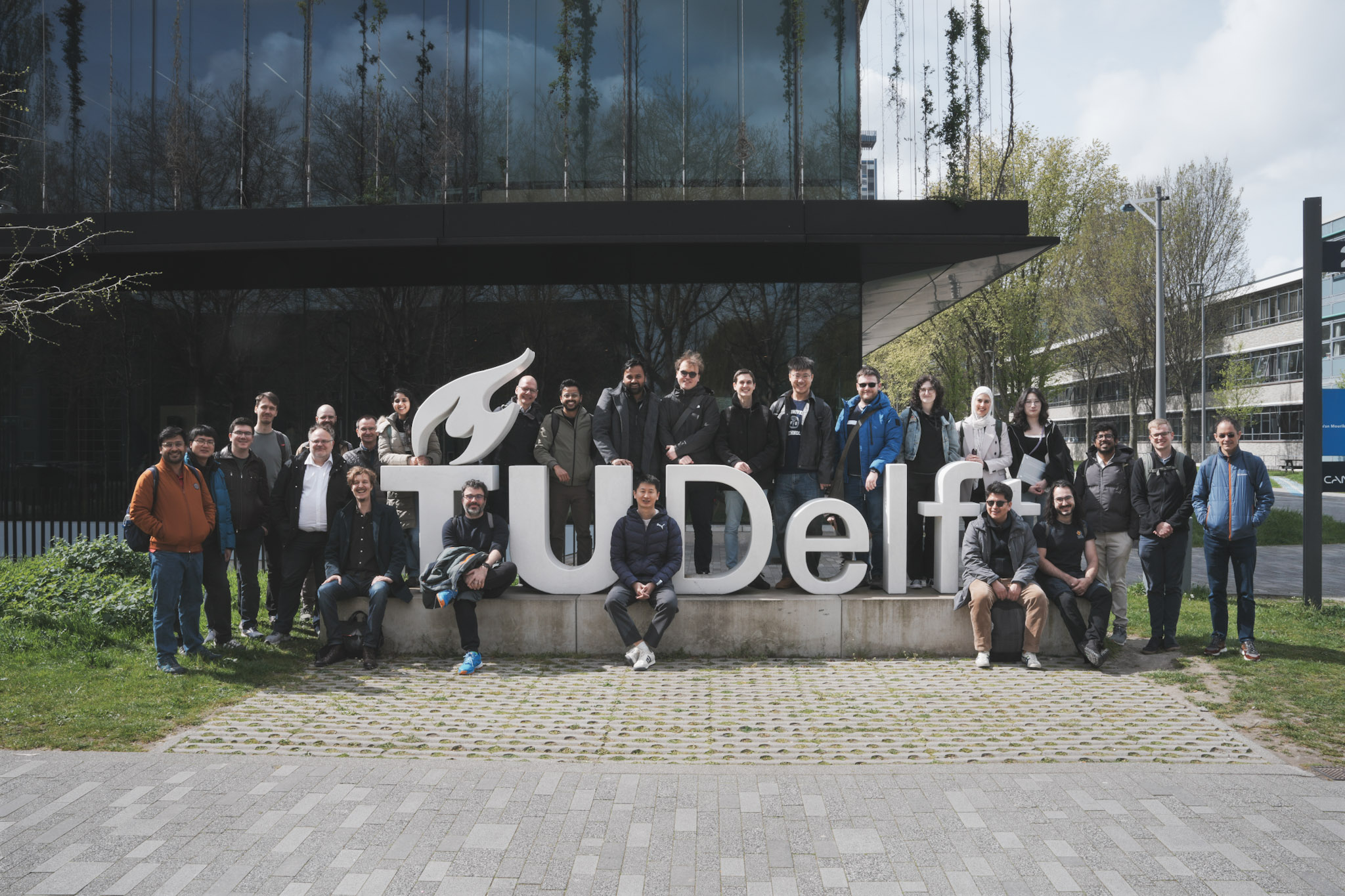
On April 10, 2026, TU Delft hosted the TUM-TUD Joint Doctoral Seminar, welcoming Prof. Jörg Ott's Connected Mobility group from TU Munich for a full day of research exchange with the Networked Systems and Cybersecurity groups at TU Delft. The seminar was co-organized by Nitinder Mohan, Fernando Kuipers, and Georgios Smaragdakis.
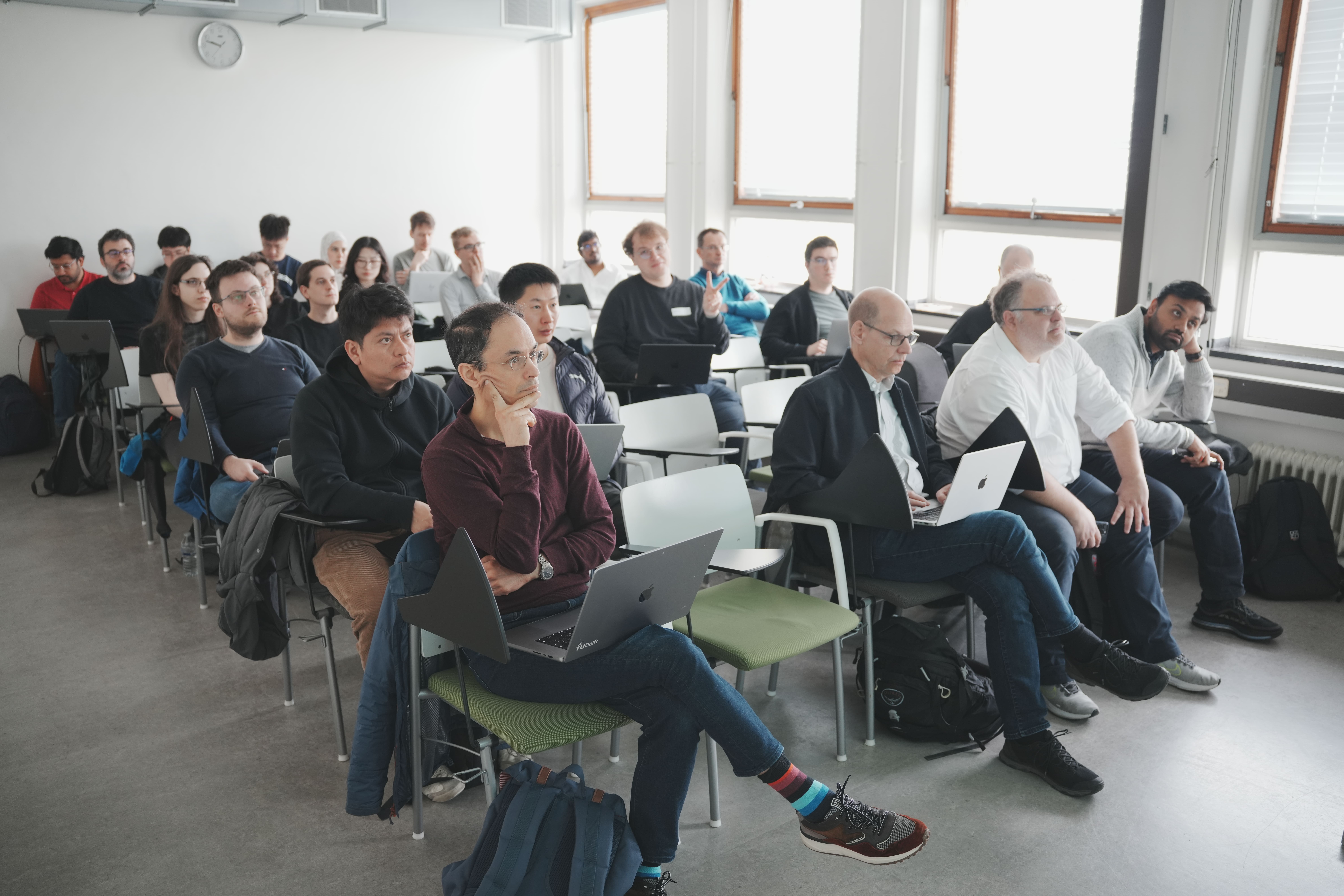
A Discussion-Driven Format
Designed as an intentionally small, discussion-driven format, the seminar brought together 30+ PhD researchers for 16 talks structured around four thematic sessions:
- Satellite & Non-Terrestrial Networks — reproducible network testbeds, Starlink content delivery, 5G/6G NTN O-RAN measurements, and lessons from Dagstuhl on Connected Space.
- 5/6G Architecture — cell-free network channel prediction, 6G core sustainability, knowledge graphs for mobile-core observability, and process-based monitoring for the O-Cloud.
- Edge & Orchestration — adaptive selective inference at the edge (ASIDE), energy-efficient MEC offloading (mApp), multi-RAT resilience strategies, and adaptive 6G telemetry.
- Security & Privacy — QUIC website fingerprinting, short-flow TCP acceleration, and emerging measurement challenges.
Each talk was deliberately kept to 10 minutes plus 5 minutes of Q&A, with the goal of surfacing open problems and ongoing work rather than polished results. The format gave PhD students room to share early-stage ideas and receive direct feedback from peers tackling adjacent questions on the other side.
Continuing the Conversation Over Dinner
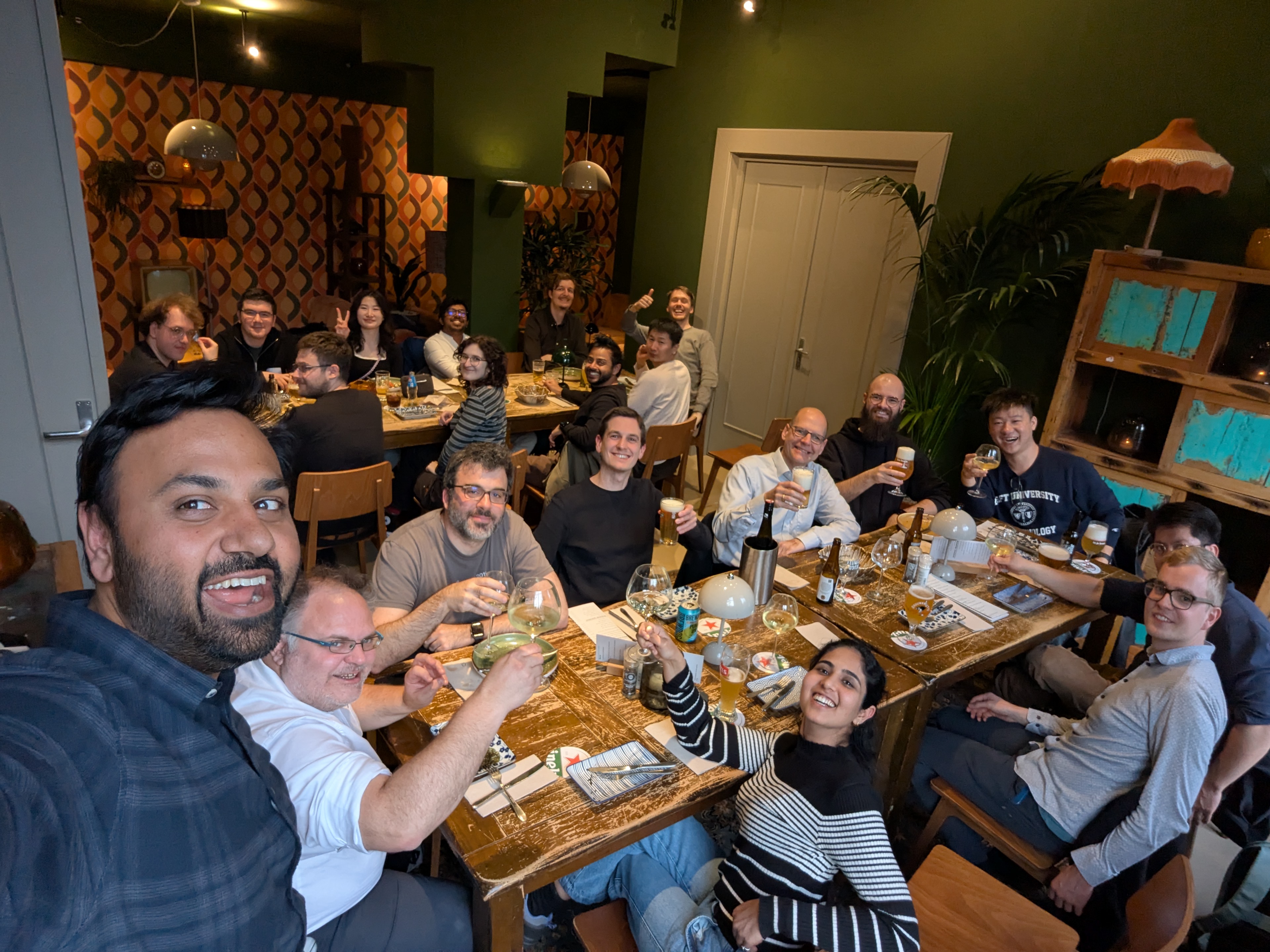
The seminar wrapped with a group dinner in central Delft — an opportunity for both cohorts to continue conversations started in the seminar room in a more relaxed setting. These informal interactions are where many of the most productive collaborations begin, and the evening lived up to that expectation.
The seminar reinforces a long-standing research partnership between the two groups across edge computing, non-terrestrial networks, and Internet measurements, and lays the groundwork for joint publications, student exchanges, and shared infrastructure efforts in the year ahead.