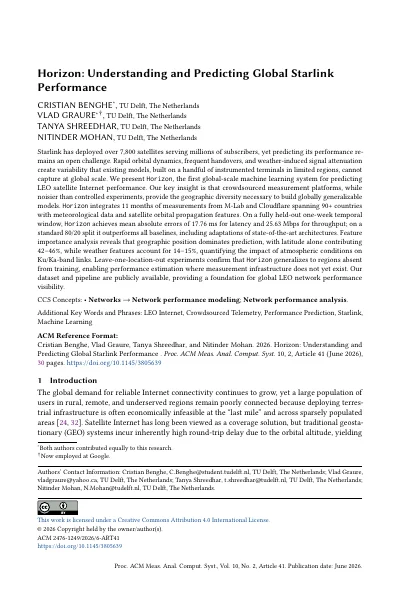
We are thrilled to share that "Horizon: Understanding and Predicting Global Starlink Performance" has been accepted at ACM SIGMETRICS 2026 — the flagship venue (CORE A*) for performance evaluation, measurement, and modeling of computer systems. The paper was accepted with a 15.2% acceptance rate (32 papers out of 211 submissions) and will appear in Proceedings of the ACM on Measurement and Analysis of Computing Systems.
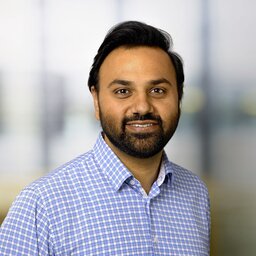
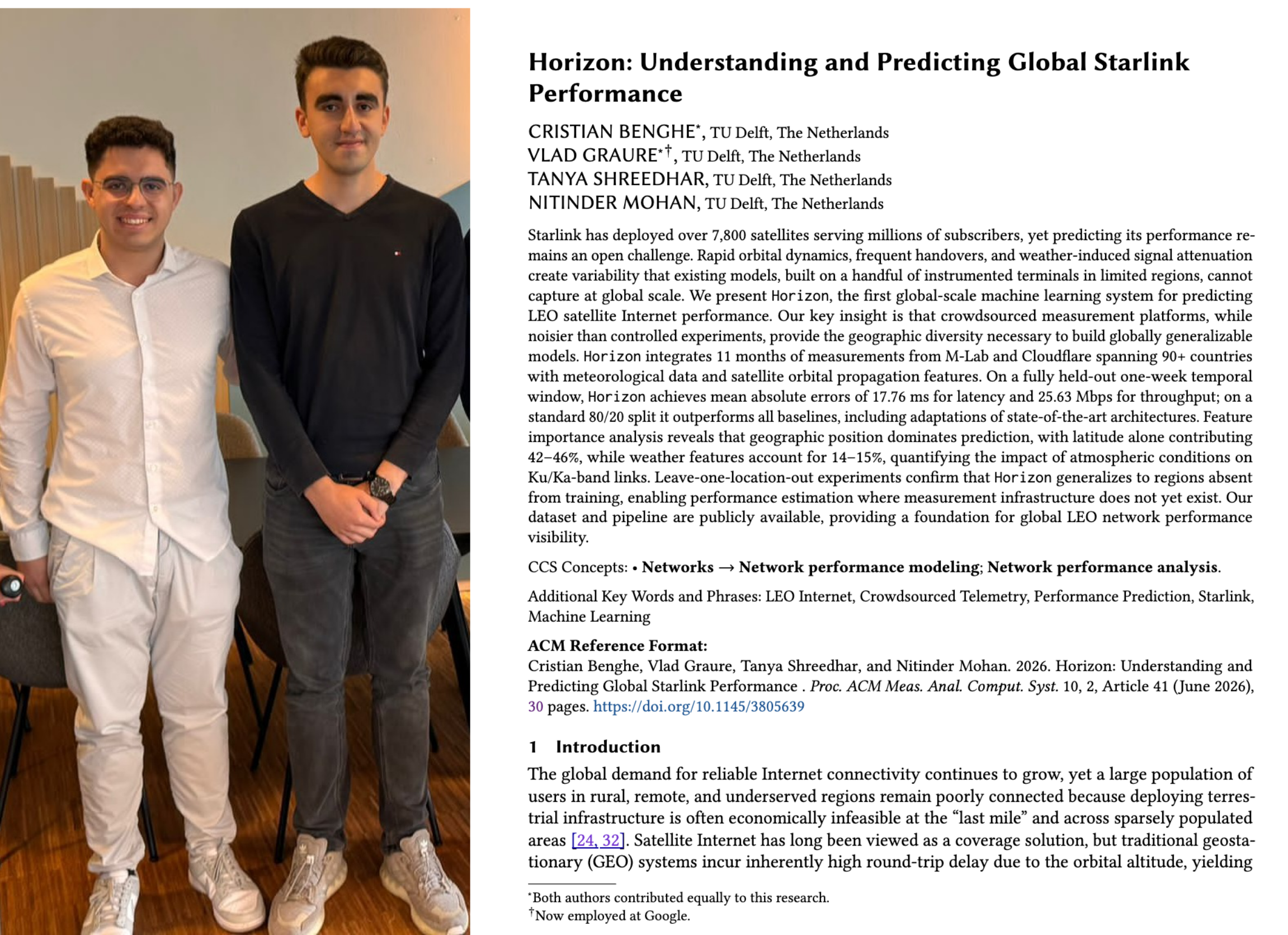
What makes this result especially meaningful: the underlying research was carried out by Vlad Graure and Cristian Benghe during their Bachelor's Research Project at TU Delft, supervised by Dr. Tanya Shreedhar and myself. The two BSc theses then formed the foundation for a follow-up effort that we extended, refined, and submitted as a joint paper. Research originating from a bachelor's project reaching a top-tier measurements venue is uncommon — and reflects the depth and rigor that Vlad and Cristian brought to the work over the past year.
What Horizon Does
Starlink now operates over 7,800 satellites serving millions of subscribers, but predicting its performance remains an open problem. Rapid orbital dynamics, frequent satellite handovers, and weather-induced signal attenuation create variability that existing models — built on a handful of instrumented terminals in limited regions — simply cannot capture at global scale.
Horizon is the first global-scale machine learning system for predicting LEO satellite Internet performance. The key insight is that crowdsourced measurement platforms, although noisier than controlled experiments, provide the geographic diversity needed to build models that generalize globally. Horizon integrates:
- 11 months of measurements from M-Lab and Cloudflare across 90+ countries,
- meteorological data, and
- satellite orbital propagation features.
On a fully held-out one-week temporal window, Horizon achieves 17.76 ms MAE for latency and 25.63 Mbps MAE for throughput. Feature importance analysis reveals that geographic position dominates prediction (latitude alone contributes 42–46%), while weather features account for 14–15% — quantifying for the first time how atmospheric conditions affect Ku/Ka-band links at scale.
In line with the lab's commitment to reproducible research, the code and dataset are publicly available.
What the Bachelor's Research Project Can Become
Vlad and Cristian's theses were produced under TU Delft's CSE3000 Research Project — the capstone bachelor course in which CSE students conduct an original research investigation under academic supervision. Like every CSE3000 thesis, both are openly archived in the TU Delft Education Repository, making them part of the public scientific record from day one.
What Horizon shows is what this format can lead to when the question is right and the students lean in: a focused 10-week investigation that, with continued effort beyond the project, becomes a publication at one of the most selective measurement venues in the field. Both authors will travel to University of Michigan, Ann Arbor (June 8–12, 2026) to present the work to the international research community.
If you are a TU Delft BSc student interested in measurement, satellite networks, or systems — and looking for a research project topic with real scientific stakes — get in touch. Horizon shows what's possible.
Congratulations, Vlad and Cristian!