KIJK, the Netherlands' long-running popular-science magazine, interviewed me for its summer 2026 edition on one of the loudest ideas in tech right now: moving datacenters into orbit. The six-page feature, "Rekenkracht in de ruimte" (Computing Power in Space, pp. 34-39) by tech journalist Tom Cassauwers, takes the claims made by Elon Musk, Google, and a wave of space-compute startups and asks a simple question. Is this technically possible, and is it economically realistic?

The KIJK summer 2026 edition, which carries the feature on orbital datacenters.
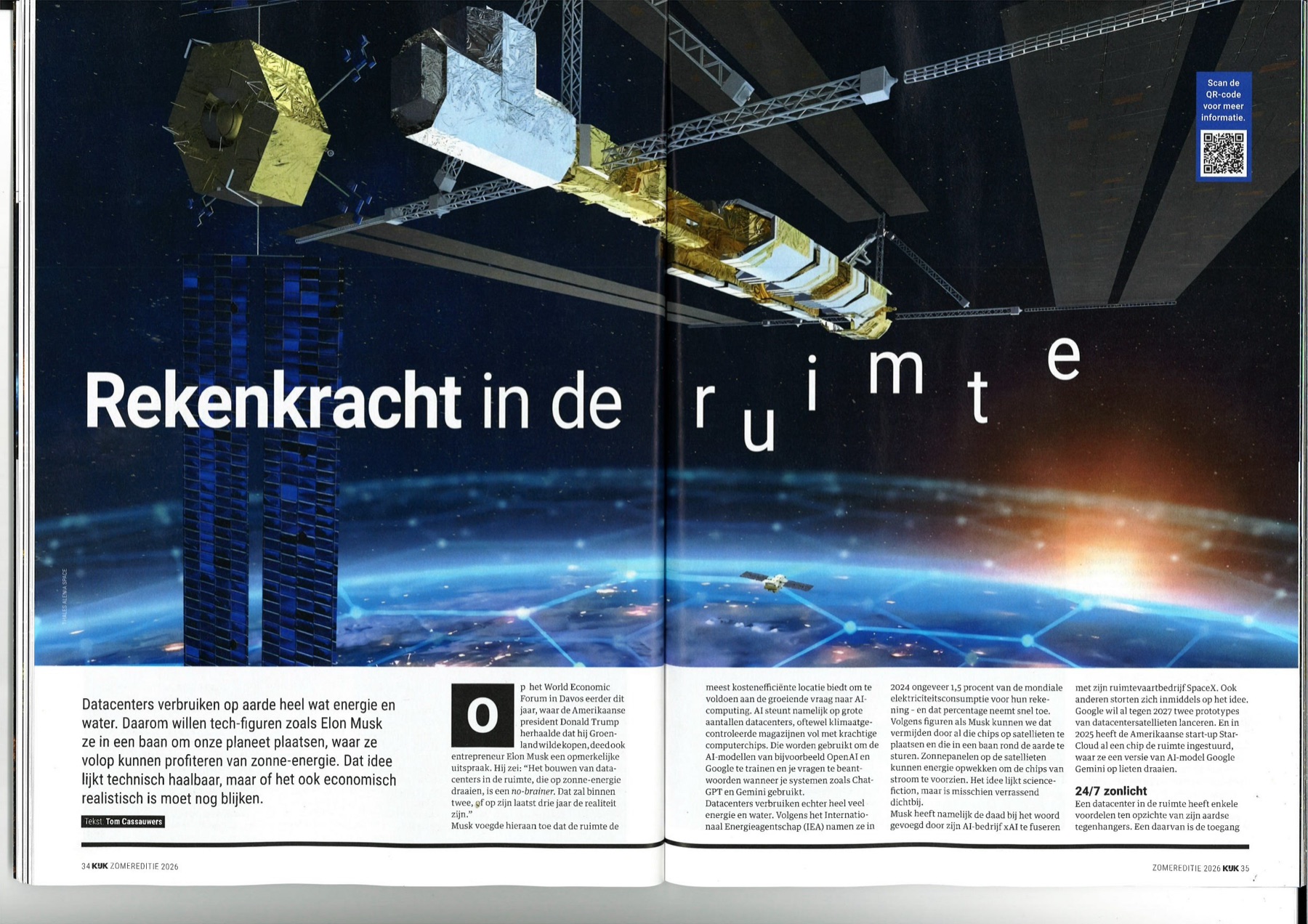
Opening spread of "Rekenkracht in de ruimte" (pp. 34-35).
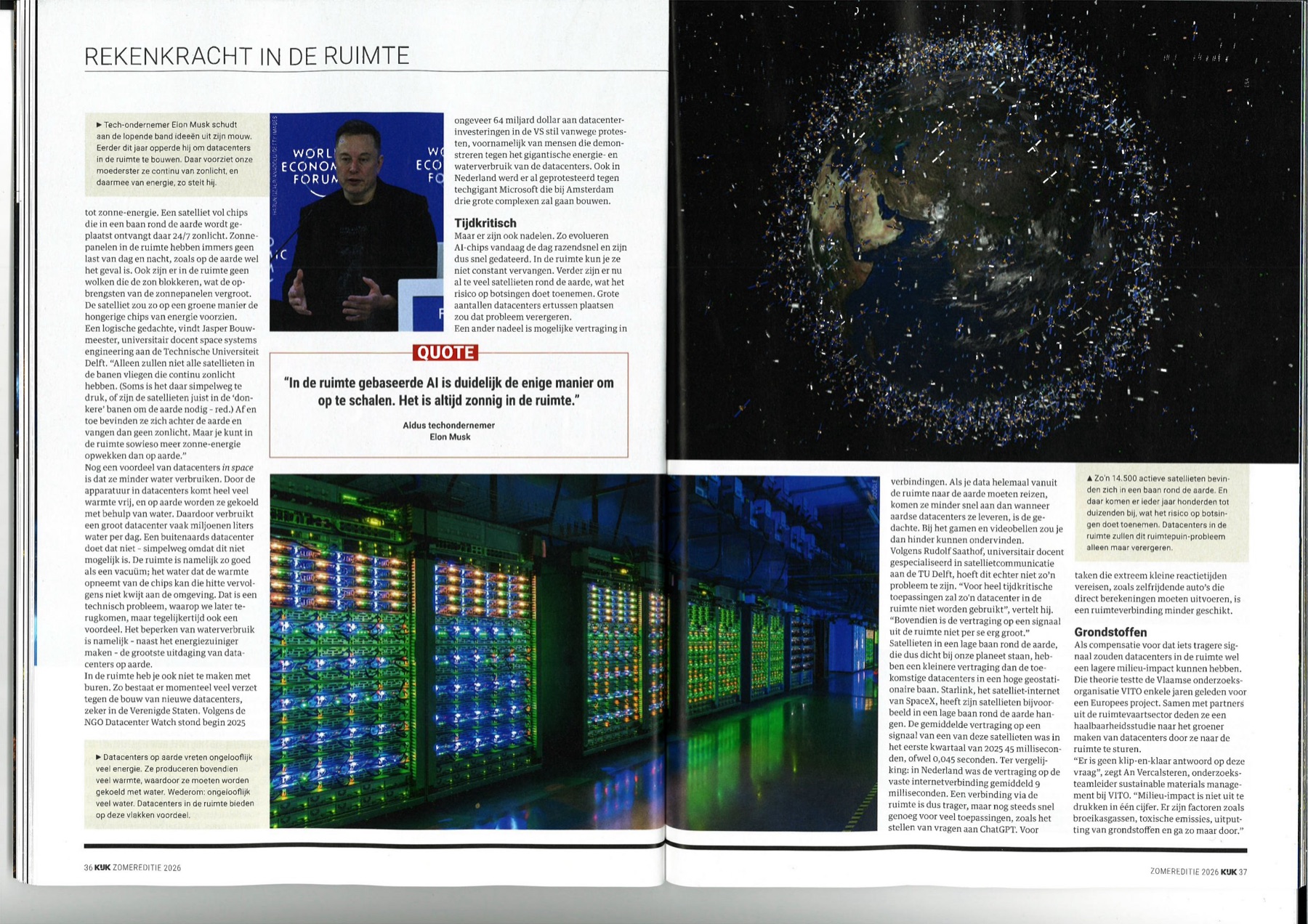
The article weighs 24/7 sunlight against latency and space debris (pp. 36-37).
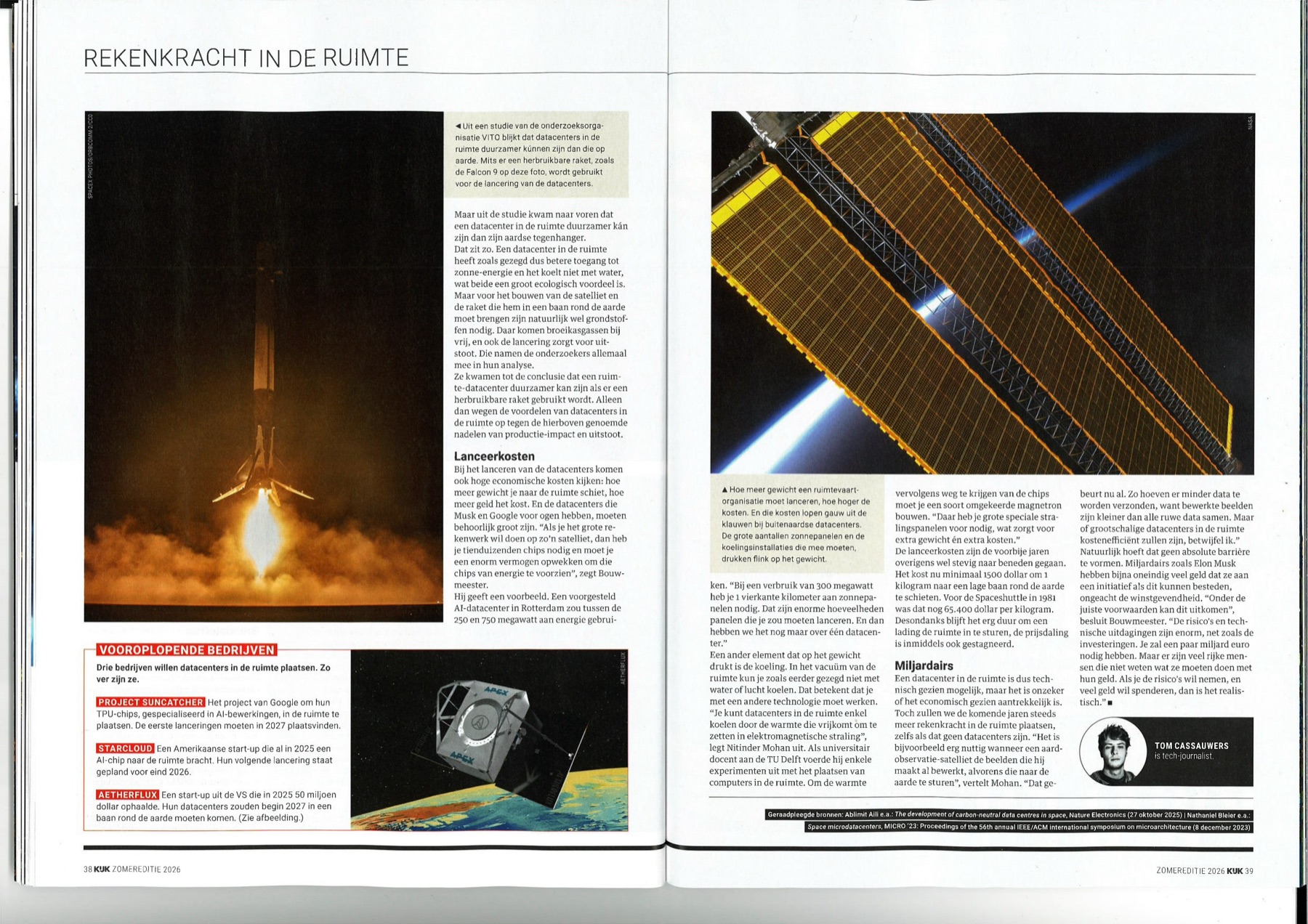
Closing spread on launch costs, cooling, and the companies betting on orbital compute (pp. 38-39).
The Cooling Problem Nobody Advertises
The pitch for orbital datacenters is seductive. Uninterrupted sunlight, no clouds, no water consumption, and no neighbours objecting to a hyperscale build. What gets glossed over is the heat.
On Earth, a large datacenter can consume millions of litres of water a day for cooling. Space removes that problem and replaces it with a harder one. As I explained to KIJK:
In space, you can only cool datacenters by converting the heat they give off into electromagnetic radiation.
A vacuum is an excellent insulator. There is no air to move and no water to carry heat away, so every watt a chip dissipates has to be radiated out. That calls for large, dedicated radiator panels, which add mass and cost to every launch. They compound the same problem the solar arrays already create. At the scale Musk and Google describe, this is not a detail. It is the design constraint.
Where Orbital Compute Actually Makes Sense
My scepticism is about scale, not about the idea. Putting more computation in orbit over the coming years is close to inevitable. It just may not look like a datacenter:
It's very useful, for example, when an Earth-observation satellite already processes the images it captures before sending them down. That is happening today. It means less data has to be transmitted, because processed images are smaller than all the raw data combined.
This is edge computing, relocated to a place where the network link is the scarcest resource. Doing the work where the data is created is a well-understood win when downlink capacity is the bottleneck, which is exactly the situation for a satellite. Hyperscale AI training in orbit is a very different proposition:
But I doubt whether large-scale datacenters in space will be cost-efficient.
A TU Delft Perspective Across the Piece
The feature draws on several TU Delft voices alongside industry claims. Jasper Bouwmeester (space systems engineering) works through the power budget: a 300 MW facility would need roughly a square kilometre of solar panels, all of which has to be launched. Rudolf Saathof (satellite communication) argues that latency is less of an obstacle than people assume, noting that Starlink averaged about 45 ms in early 2025 against 9 ms on a fixed Dutch connection. That is slow by terrestrial standards but adequate for many workloads, though not for hard real-time tasks that demand single-digit milliseconds. An Vercalsteren of the Flemish research organisation VITO presents a life-cycle analysis finding that an orbital datacenter can be more sustainable than a terrestrial one, but only if it launches on a reusable rocket once manufacturing and launch emissions are carried in the accounting.
The article also surveys the companies already committed: Google's Project Suncatcher, with first launches targeted for 2027, the US startup Starcloud, which put an AI chip in orbit in 2025, and Aetherflux. Taken together, the picture is one of a technically feasible idea whose economics remain genuinely unsettled.
Read the full article (Dutch): Rekenkracht in de ruimte, KIJK Zomereditie 2026 (PDF)
About KIJK: KIJK is among the best-known popular-science magazines in the Netherlands, first published on 5 October 1968. It covers science, technology, nature, and history for a general audience, appears every four weeks (13 issues a year), and reaches roughly 227,000 readers. It is published by Roularta Media Nederland. The orbital-datacenter feature ran in the magazine's extra-thick summer double issue, listed in the contents as "Buitenaardse bits: De haalbaarheid van datacenters in de ruimte."