SPEAR Lab's satellite network research reached one of the Middle East's most influential newsrooms this week. The National — the UAE's leading English-language news publication, headquartered in Abu Dhabi and read across the Gulf and internationally — turned to Nitinder Mohan as an expert voice for its feature "Starlink spearheads satellite internet boom, but other players are set to launch" by science reporter Daniel Bardsley. For a lab that studies how LEO mega-constellations actually behave, being asked to explain that behavior to the readership of the Gulf's paper of record is exactly where our measurements are meant to land.
The Story: A Market at Its Inflection Point
The article captures satellite Internet at a remarkable moment. Starlink reported 12 million customers in Q2 2026 — double a year earlier — and Grand View Research projects the market to nearly triple from $13.3 billion today to $35.7 billion by 2033. The UAE illustrates both the demand and the bottleneck: Starlink operates there under a decade-long licence from Dh300 a month, but is currently closed to new customers because the service is at capacity. Meanwhile, the challengers are arriving — Amazon's Leo is expected to open to consumers around the turn of the year, and Blue Origin's TeraWave is targeting corporate and government connectivity. Arthur D Little's Andrea Faggiano tells the paper satellite technology could claim 15 per cent of the overall Internet market within 15 years, and the University of Surrey's Prof. Nishanth Sastry describes everyday Starlink performance as nearly indistinguishable from a terrestrial connection.
SPEAR Lab's Role: Grounding the Boom in Measurement
The National drew on our expertise for the questions that marketing figures cannot answer, and our contributions frame the article's core argument:
- Where the market is heading. We expect satellite connectivity to keep growing for at least the next decade — driven not only by consumers but by aviation and maritime operators, the segments where terrestrial infrastructure was never an option.
- Why capacity is the real constraint. A constellation's capacity is not something software updates can conjure; it grows by putting up more and larger satellites with larger antennae. Starlink's ongoing Version 3 deployment — satellites substantially bigger than anything it has flown before — is precisely an attempt to lift the ceiling that has left markets like the UAE waitlisted.
- Who should actually switch. Our honest assessment, and the article's practical takeaway for readers in fibre-rich countries like the UAE: if you already have fibre, satellite gains you little. Its transformative value is in the mountains, deserts, and remote regions where fibre roll-outs will never pencil out — there, satellite connectivity is a boon.
The Research Behind the Commentary
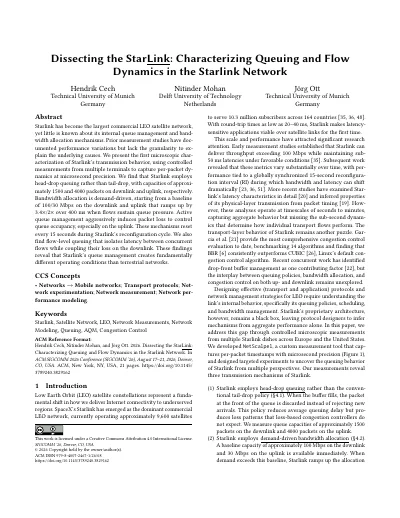
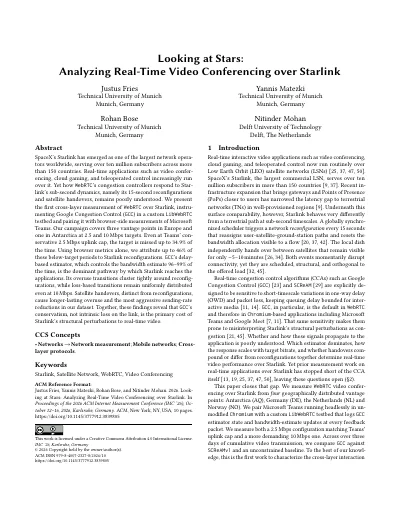
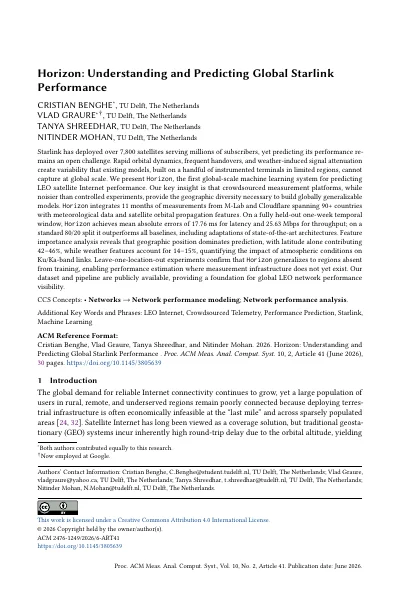
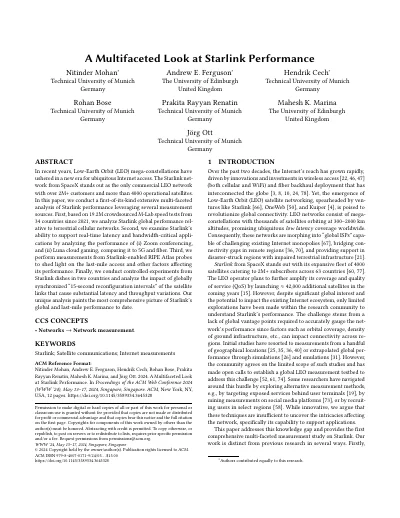
None of this commentary is opinion from the sidelines — each point traces directly to SPEAR Lab's measurement record. Our WWW 2024 study analyzed Starlink from 34 countries using nearly 20 million measurements, establishing globally where satellite competes with terrestrial networks and where it falls short — the empirical basis for the fibre-versus-satellite advice. Our SIGCOMM 2026 paper opened up Starlink's internals packet by packet, revealing how the network allocates bandwidth on demand from a 100/30 Mbps baseline — the mechanics behind why capacity, not coverage, is the binding constraint. Horizon, our SIGMETRICS 2026 system, predicts Starlink performance anywhere on Earth — including regions like the Gulf where vantage points are scarce. And our IMC 2026 measurement of video conferencing over Starlink quantifies what the network's sub-second dynamics mean for the applications people actually use.
Read the full article: Starlink spearheads satellite internet boom, but other players are set to launch — The National