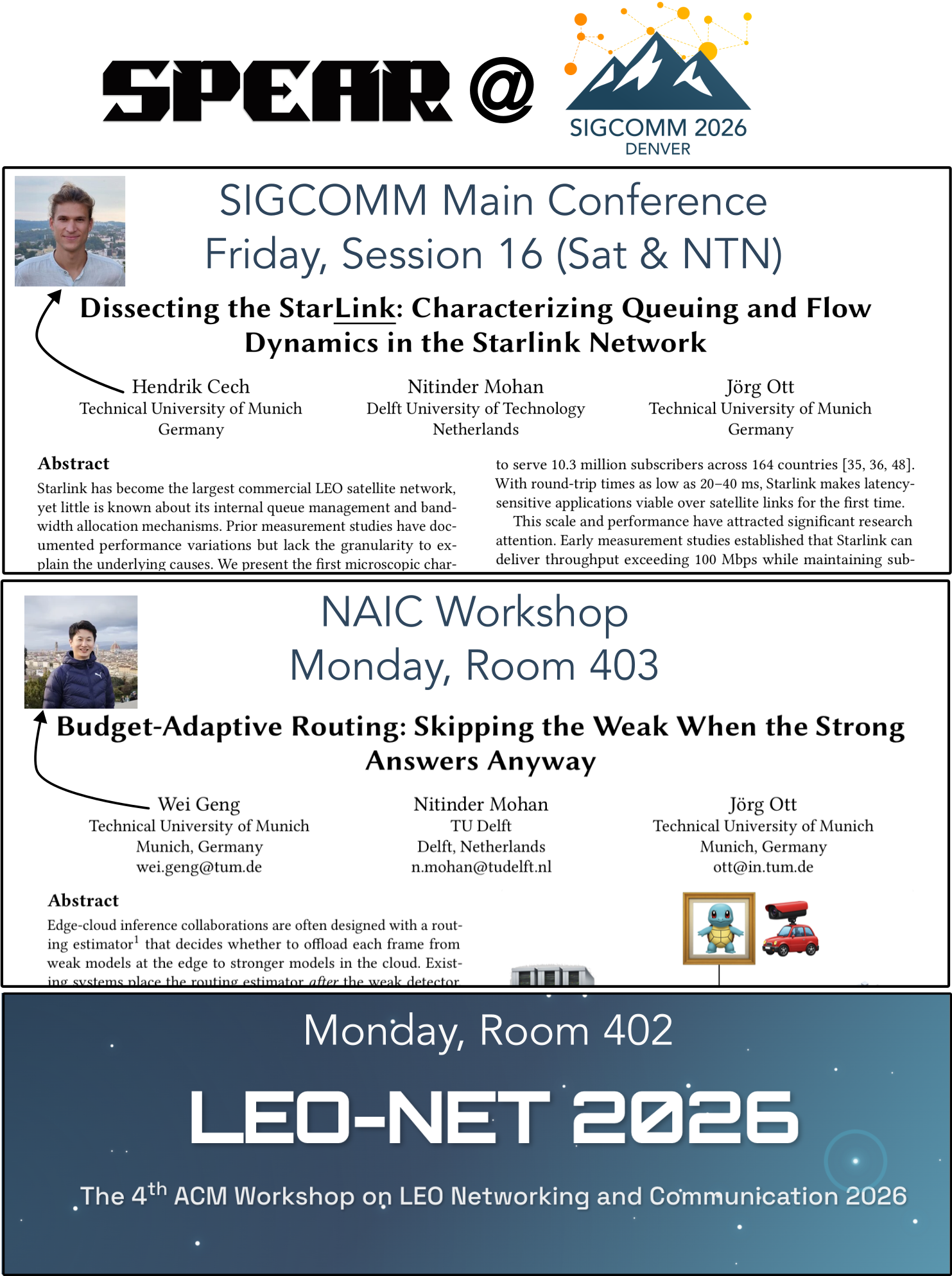
SPEAR Lab is heading to ACM SIGCOMM 2026 in Denver next week — and we are bringing a full program with us. A main-conference paper that opens up Starlink's internal machinery packet by packet, a workshop paper that rethinks where the routing decision belongs in edge-cloud inference, and the fourth edition of LEO-NET, the ACM workshop on LEO networking and communication that I co-chair. If you are in Denver, come find us. 🛰️ 🤖
Dissecting the StarLink — Main Conference, Friday (Session 16: Satellite & NTN)
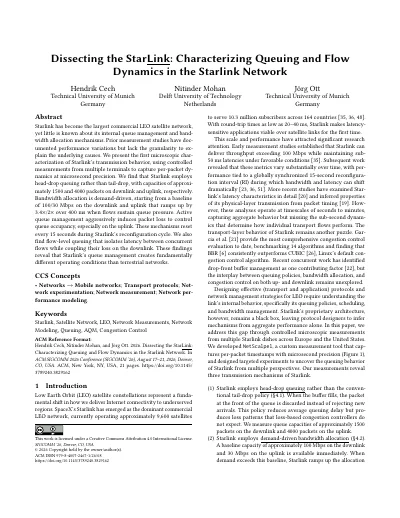
On Friday, Hendrik Cech presents Dissecting the StarLink: Characterizing Queuing and Flow Dynamics in the Starlink Network — joint work with Jörg Ott (TU Munich) and myself — in the main conference's session on satellite and non-terrestrial networks.
Starlink is now the largest commercial LEO network, serving over 10 million subscribers across 164 countries, yet how it manages queues and allocates bandwidth internally has remained a black box. Prior measurement studies documented the performance swings; they could not explain their causes. This paper is the first microscopic characterization of Starlink's transmission behavior, built on per-packet measurements at microsecond precision from controlled terminals in Europe and the US. What emerged is a picture of a network that behaves fundamentally unlike terrestrial infrastructure:
- Head-drop queuing, not tail-drop. When Starlink's queues fill (roughly 1,500 packets on the downlink, 4,000 on the uplink), the oldest packet is discarded first — the opposite of what most transport protocols are designed to expect.
- Demand-driven bandwidth allocation. Every terminal starts from a baseline of about 100/30 Mbps down/up. To get more, traffic has to actively sustain queue pressure, after which the allocation ramps up by 3.4x (downlink) and 2x (uplink) over roughly 400 ms.
- Deliberately lossy AQM. Starlink runs an aggressive active queue management scheme, especially on the uplink, that induces packet loss to control queue occupancy well before buffers are full.
- A 15-second reset cycle. All of these mechanisms reset during Starlink's periodic reconfiguration, even when the serving satellite has not changed.
- Flow-level queuing. Concurrent flows are isolated in latency but coupled in loss on the downlink.
Together, these mechanisms finally explain something the community has observed without a clean answer: why BBR thrives on Starlink while loss-based congestion control like CUBIC struggles. CUBIC reads Starlink's deliberate AQM drops as congestion and backs off — at precisely the moment it needs to keep pushing to defend its bandwidth allocation. The measurement tool stltrace, the analysis code, the dataset, and the paper (PDF) are all public.
Budget-Adaptive Routing — NAIC Workshop, Monday, Room 403
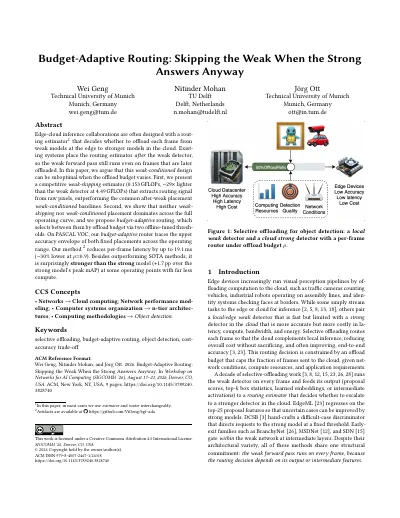
On Monday, Wei Geng presents Budget-Adaptive Routing: Skipping the Weak When the Strong Answers Anyway — joint work with Jörg Ott and myself — at the Workshop on Networks for AI Computing (NAIC).
Edge-cloud inference systems typically pair a weak model at the edge with a strong model in the cloud, and use a routing estimator to decide per frame whether to offload. The catch is architectural: existing systems place that estimator after the weak detector, so the weak model runs on every single frame — including the ones the cloud ends up answering anyway. That is a hidden compute tax on exactly the frames where the edge contributes nothing.
This work presents the first competitive raw-pixel routing estimator — one that decides directly from the input frame, before any edge inference runs. When the estimator routes a frame to the cloud, the weak detector is skipped entirely, cutting up to 19.1 ms of latency per frame while the overall system beats the strong model alone on accuracy. The estimator is budget-adaptive: it targets an offloading budget and spends it on the frames where the strong model's advantage is largest. The code and the paper (PDF) are available.
LEO-NET 2026 — Monday, Room 402
Also on Monday, right next door, I am hosting LEO-NET 2026, the 4th ACM Workshop on LEO Networking and Communication, together with my co-chairs Deepak Vasisht (University of Illinois Urbana-Champaign) and Debopam Bhattacherjee (Microsoft Research). After editions at MobiCom and SIGCOMM, LEO-NET has become the meeting point for the community working on mega-constellation networking, and this year's program is our strongest yet:
- Fifteen papers across three sessions, spanning LEO transport and measurement, constellation architecture, and space computing.
- A keynote by Nick Matthews (Amazon Leo) with a behind-the-scenes look at how a mega-constellation network is actually being designed, built, and operated.
- A closing panel on the open challenges and opportunities in LEO computing, communication, and networking.